MÓGŪSELECTED WORK
REBRAND AND WEBSITE
VIEW LIVE WEBSITE →The project
I expanded MÓGŪ’s existing green-and-black palette into a complete brand system and carried it through a full rebrand: a new custom-coded moguchinese.com, social content and Meta ads.
What I did
I developed a complete visual and verbal identity around MÓGŪ’s existing colors. I added orange and beige accents to complete the palette, picked the fonts, and wrote all of the brand language, copy and tone. I came up with the photoshoot concepts, hired the models and directed the shoots, including the menu shoot against a green background whose photos are used across third-party ordering platforms. I translated the rebrand across the website, social and Meta ads, and on the web I audited the old site, then designed, built and maintained the new one in custom code inside Squarespace.
Before: the original website
The original WordPress site used Oswald and Roboto. I captured its pages before the rebuild to document the starting point, then redesigned the site around MÓGŪ’s expanded brand system, new copy and photography.
Design and implementation
Project context
The old site ran on WordPress, was set in Oswald and Roboto, and carried hidden spam on almost every page. The new one uses the brand system throughout: green and black with orange and beige accents, Outfit headlines, my copy and photography from the shoots. Squarespace’s built-in sections couldn’t produce the layouts, so every page is custom HTML, CSS and JavaScript in Squarespace code blocks, sharing one stylesheet and one script.
The pages
Home
I organized the homepage around discovering the food, finding a restaurant and placing an order. Catering and locations are one step away from anywhere on the page.

Menu
I gave every menu category its own chapter and built a sticky bar of category tabs that follows the scroll. The page closes on one order button.

Locations
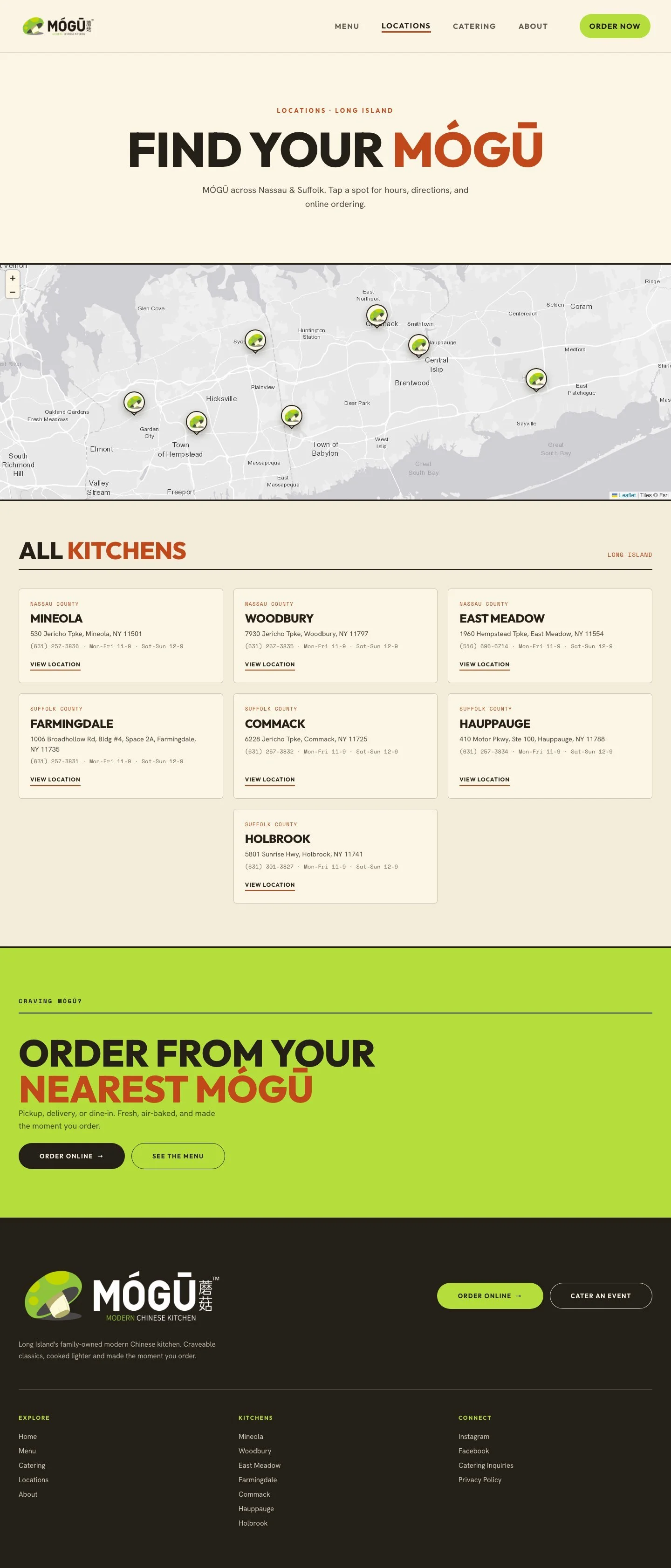
I built a custom map of Long Island using the MÓGŪ mushroom logo as the location markers, with a card for every restaurant linking to its page.
Motion
Every animation switches off for visitors who set reduced motion in their system settings.
The homepage
The letters of MÓGŪ and 蘑菇 rise into place one at a time, followed by the tagline, the Edible Long Island quote and the buttons, while the hero photo zooms slowly. Farther down, text fades up and photos wipe open as they reach the screen.
Phone entrance
I sized the same entrance and reveals to run on phone screens.
Positioning
With the owner, I moved MÓGŪ’s message away from health claims and toward family recipes and Long Island. I rewrote the lead copy across the site to match. The homepage now opens: “Long Island’s family-owned modern Chinese kitchen. The craveable classics you love, made from family recipes.”
- Before
- The lead copy talked about what the food left out: no MSG, no fryers, healthier Chinese food
- After
- A family-owned modern Chinese restaurant, born on Long Island, cooking the classics from family recipes
- Cooking method
- Air-baked and made to order, moved into a supporting line about freshness
- Cut
- The no-MSG claim, removed from every page
Decisions along the way
I held every page to these four rules.
- Full width, color-blocked
- Every section runs edge to edge in its own color band
- Real photography
- Photos from MÓGŪ’s own shoots, set flat
- Short declarative copy
- “One tray, ten people.” “Bring big appetites.” “No heat lamps, ever.”
- One fixed headline
- The hero holds one headline, animated on entrance, at every screen size
Technical audit
Project context
Before replacing the old moguchinese.com, a WordPress site run by MÓGŪ’s previous web vendor, I captured all of it: a browsable mirror, full-page screenshots, the raw HTML of every page and a spreadsheet of each page’s contents. The capture turned up casino spam hidden on 29 of 30 pages.
What was hidden
Pages that looked clean carried blocks of casino affiliate text and links, pushed far off the edge of the screen with CSS, at positions like left: -348921px, so visitors never saw them but search engines still read them.
I counted the hidden links and keywords by page and listed the repeated domains and off-screen CSS for the developer to trace.
<div style="position:absolute; left:-612438px;">
  Discover <a href="https://spinmate88-casino.com/" target="_blank" rel="noopener">Spinmate Casino</a>
  designed for an engaging online experience for Australian players. ...
</div>
Served to everyone
I captured every page twice, once as a normal Chrome browser and once identifying as Googlebot. The HTML matched page for page, so the spam was served to everyone, not only to search engines.
A user-agent test can’t rule out cloaking by IP address, so my write-up points to Search Console’s URL Inspection to confirm what Google actually crawled.
Doorway posts
I flagged six WordPress posts with high, clustered IDs (3089, 3098, 3393, 3508, 3722 and 3844) that carried the same injection and weren’t in the site’s sitemap. That pattern is consistent with content inserted in bulk.
Cleanup steps for the developer
I wrote these steps for MÓGŪ’s developer and host.
- Search the database
I identified the WordPress content, theme and plugin locations the developer should inspect for the repeated links and off-screen styles.
- Find the injector
The identical blocks on every page pointed to a theme template or plugin adding them at render time, not edits to individual posts.
- Confirm with Google
I included follow-up validation through Search Console after the developer completed cleanup.
Updates after launch
- Catering ordering on Toast
July 2026. Every catering link moved to Toast when it replaced ezCater.
- A seventh restaurant
August 2026. A page for the new restaurant, added to the map, the restaurant rail, the footer and the structured data.
- Restaurant structured data
September 2026. The site had no Restaurant markup. Every restaurant page got its own, and the locations page lists them all.
- New menu photography
September 10, 2026. 31 of the 49 menu items moved to new photos. I reset the menu cards so every plate shows in full.